
solar battery storage
Solar Battery Storage and Florida Outage Season: What Backup Power Actually Covers
By UnionGrid TeamUpdated 7 min read
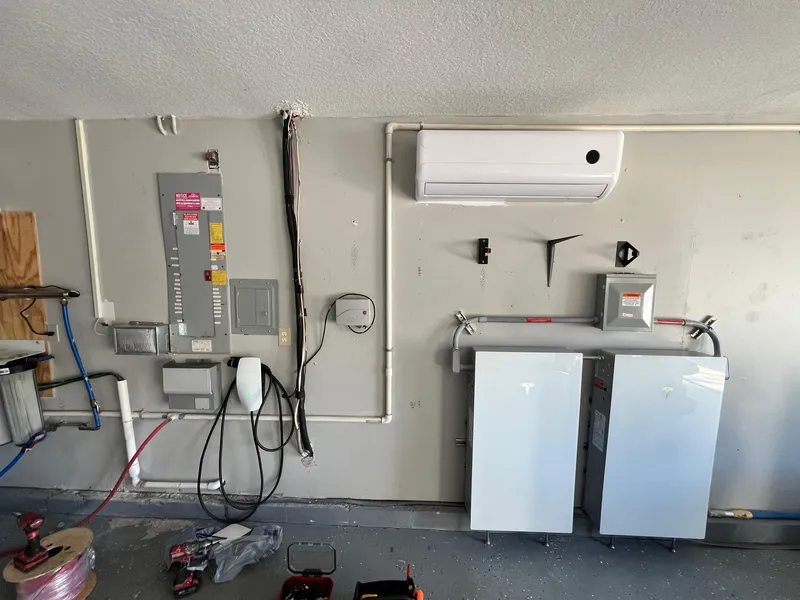
If you've lived through a Florida summer, you already know the drill. The afternoon sky turns the color of a bruise, the wind picks up, and somewhere between the first crack of thunder and dinner, the lights blink out. Between routine storms and the occasional named hurricane, outages are just part of the deal here — and they're the number one reason homeowners ask us about battery storage.
But there's a gap between what people expect a battery to do and what it actually does. A battery is not a magic switch that makes an outage disappear. It's a tool with real limits, and understanding those limits is the difference between a system that keeps you comfortable and one that leaves you frustrated at 2 a.m. Let's walk through what backup power actually covers, how sizing works, and what a realistic picture looks like for a Florida home.
What a home battery actually powers during an outage
Here's the first thing that surprises people: a standard grid-tied solar system, on its own, shuts off during an outage. That's not a defect — anti-islanding protection keeps the array from energizing utility lines while crews restore service. Outage power requires listed equipment that isolates the home from the grid, most commonly a battery-based backup system; a few specialized inverter configurations can provide limited daytime power without storage.
A battery changes that. When the grid drops, a battery with backup capability isolates your home from the utility and keeps power flowing to whatever circuits it's connected to. The key phrase there is "whatever circuits it's connected to" — because in almost every real installation, a battery isn't running your entire house.
Think about what draws power in your home. There are the small, steady loads: your refrigerator, some lights, ceiling fans, phone and laptop chargers, a Wi-Fi router, maybe a garage door opener. Then there are the big loads: central air conditioning, an electric water heater, an electric range or oven, a pool pump, a clothes dryer. The small loads sip electricity. The big loads gulp it.
Many Florida homeowners set up their battery to back up a chosen set of essential circuits — the fridge, key lights, outlets for charging devices, a few fans, and often the internet and a garage door. Whether one battery lasts a few hours or more than a day depends on usable capacity and the actual load profile, so the proposal should include a load-based runtime estimate rather than a blanket promise.
The moment you add central AC to that list, the math changes fast. Air-conditioning systems can draw several kilowatts while running and may also have substantial startup requirements. The battery and inverter must support both the power demand and the desired runtime; meeting one does not guarantee the other.
Sizing a battery for Florida outage season
Battery capacity is measured in kilowatt-hours (kWh), and "how big do I need" is really two questions rolled into one: how much do you want to run, and how long do you want it to last?
A useful way to think about it is an energy budget. Many residential products provide roughly 10 to 15 kWh of usable capacity, but the nameplate alone does not determine runtime. Appliance energy use varies by model, age, duty cycle, weather, and household behavior, and some stored energy is lost in conversion or held in reserve.
Now add central air. A system drawing several kilowatts while running can consume several kilowatt-hours for each hour of continuous operation. Supporting it may require additional battery capacity, sufficient inverter output, compatible startup equipment, and load management. The required design cannot be reduced to a universal battery count.
A few Florida-specific things shape the right size for your home:
- Your must-run list. For medical equipment, document each device's rated and startup loads, required runtime, and manufacturer guidance. Do not assume a CPAP, oxygen concentrator, or other device has a standard power profile; keep a separate outage plan developed with the health-care provider and device supplier, and notify the utility as recommended.
- Household size and habits. A family of five opens the fridge more, runs more fans, and charges more devices than a retired couple. Real usage matters more than square footage.
- Well and septic homes. If you're on a private well, your water pump is electric — no power, no water. That's an essential circuit many inland Florida homeowners forget until it's too late.
- Heat tolerance. Some households are genuinely fine with fans and open windows for a day or two; others have a family member who can't safely go without cooling. Be honest with yourself here, because it drives the entire design.
There's no one-size-fits-all answer, and anyone who quotes you a battery count before asking what you want to run is guessing. When we do an assessment, we start with your circuit list and work backward to capacity — not the other way around.
Panels plus a battery: the Florida advantage
Here is where solar can extend backup. A stand-alone battery is a fixed energy reserve until it can recharge. Pair it with compatible solar, islanding controls, and an inverter designed for outage operation, and daytime production can serve loads and recharge the battery while the grid is down.
During a multi-day outage, a properly designed system may settle into a daily rhythm: panels serve loads and recharge the battery during available sun, then the battery carries selected loads after production falls. Survival still depends on weather, shade, array output, battery state, and disciplined energy use; solar does not guarantee indefinite backup.
Two honest caveats. First, right after a hurricane passes, skies are often overcast for a day or two, and cloudy days cut panel output significantly — so don't plan around full sunshine the morning after a storm. Second, your system has to be designed for solar to keep charging the battery during an outage; not every configuration does this automatically. It's a specific capability worth confirming, and it's a standard part of how we design a battery storage system.
Setting realistic expectations
The homeowners who are happiest with their batteries are the ones who went in with a clear picture. So let's be straight about the trade-offs.
A battery sized for essentials is not a replacement for a whole-home generator running your AC around the clock. A properly configured system can transfer selected circuits automatically after its designed switchover interval and, when paired with compatible solar, may recharge during available sun. The runtime and recharge rate still depend on the design and conditions.
If your goal is to run larger loads such as central air, a multi-battery design and load management may support them for a modeled period. No finite battery system can promise indefinite whole-home backup, and poor solar weather can extend beyond the stored reserve.
A couple of practical notes for Florida specifically. Battery location must follow the manufacturer's temperature, clearance, environmental, and mounting requirements along with the applicable electrical and fire codes. If storage is installed with a new array, it is also a natural time to assess the roof. Addressing necessary roof work first may avoid a later panel removal and reinstall. UnionGrid can coordinate the roof and solar scopes, while the proposal and permits should name the appropriately licensed contractor responsible for each.
Outage season isn't going anywhere. The question is whether the next storm means a scramble for ice and flashlights or just a quieter-than-usual evening with the fridge humming along. If you want a system sized to what your household actually needs — not an off-the-shelf guess — tell us which circuits matter most and we'll build the design around them. Start with a free quote or explore our solar options, and we'll walk you through realistic numbers for your home.
Sources checked
- U.S. Department of Energy: Solar and Resilience Basics
- National Laboratory of the Rockies: critical-load backup with solar and storage
- U.S. Food and Drug Administration: preparing home medical devices for power outages
- Florida DBPR license verification
Sources reviewed August 20, 2026.
Frequently asked questions
Can a solar battery run my whole house during an outage?
Only if the battery, inverter, switchgear, and load-management design support both the home's peak power and the desired runtime. Large loads such as central AC, electric water heating, and pool equipment can exceed a single unit's output or deplete it quickly. Compare an essential-circuits design with a whole-home design using documented load data.
Will my solar panels charge the battery during a multi-day outage?
They can when the system has compatible islanding controls and an inverter configured to power loads and charge storage while disconnected from the grid. Available solar production, household loads, shade, weather, reserve settings, and battery limits determine how much it recharges; a full daily recharge is not guaranteed.
Does my regular grid-tied solar keep working when the power goes out?
A standard grid-tied array shuts down during an outage for anti-islanding safety. Outage power requires listed equipment that can isolate the home from the grid; this is commonly a battery-based backup system, although some specialized inverter configurations can provide limited daytime power without a battery. Confirm the exact capability in the design.
How long will a battery power my home during a Florida outage?
It depends on usable battery capacity, state of charge, inverter power, conversion losses, reserve settings, appliance startup loads, and how long each load runs. A runtime estimate should be built from a measured or documented critical-load list. Solar can extend runtime only when the system is designed to operate and recharge during an outage.
Related reading
Solar Battery Storage
How home battery storage works and what it costs across our Florida service area.
Learn moreResidential Solar Installation
Pairing panels with a battery for outage resilience and lower bills.
Learn moreFlorida Solar Incentives 2026
Current programs and credits that affect the cost of solar and storage in Florida.
Learn moreGet a Free Quote
Tell us which circuits you want backed up and we'll size a system for it.
Learn moreReady to talk about your project?
Tell us what you need and our team can help you take the next step with solar, roofing, battery storage, or roof-related solar work.