
how solar panels work
How Do Solar Panels Work? A Simple Guide for Florida Homeowners
By UnionGrid Team6 min read
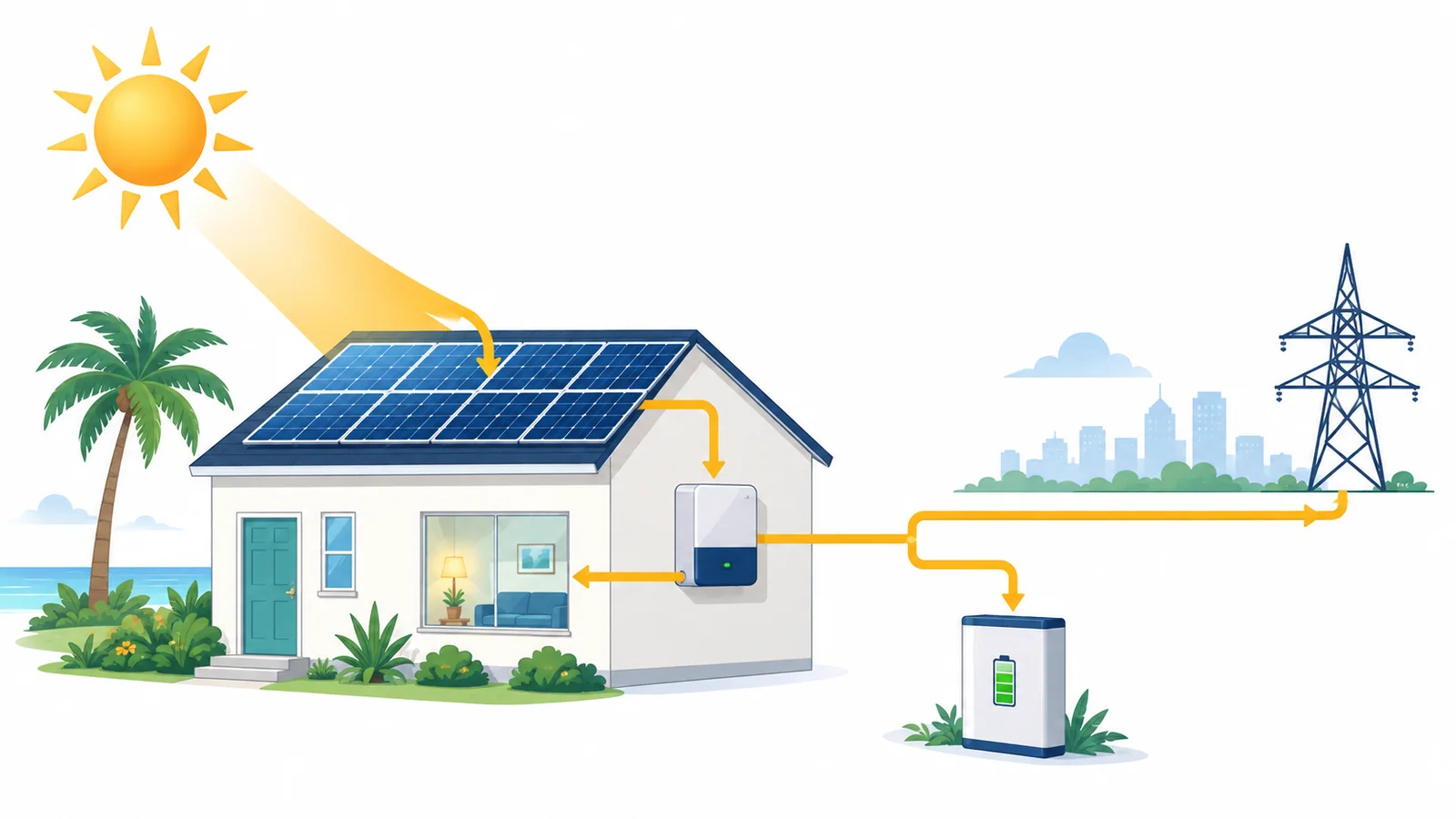
If you have ever looked at a sunny Florida roof and wondered, “How do solar panels work?”, the short answer is simple:
Solar panels turn sunlight on your roof into electricity your home can use.
There is more equipment behind that sentence, but the full journey is easy to follow. Sunlight reaches the panels. The panels make electricity. An inverter prepares it for the home. The home uses it first. Extra energy can charge a battery or move to the utility grid.
Here is each step in plain English.
The complete home solar journey in 30 seconds
- The Sun sends light to Earth.
- Sunlight carries energy to the roof.
- Solar panels turn part of that light into electricity.
- An inverter prepares the electricity for normal home wiring.
- The home uses solar electricity as it is produced.
- Extra energy can charge a battery or flow to the grid.
- At night, a battery or the grid supplies the home.
You do not need to flip switches as production changes. A properly installed system manages the flow automatically.
Step 1: sunlight carries energy
The Sun gives off electromagnetic radiation, which we usually call sunlight. That light carries energy across space and down to your roof.
Sunlight is not just ultraviolet light. It includes visible light, infrared light, and ultraviolet light. Solar cells respond to a useful range of that light.
Scientists describe light as tiny packets called photons. You do not need to remember the word. The useful idea is this:
Sunlight brings energy to the panel.
Step 2: solar cells turn light into electricity
A solar panel is made of many smaller solar cells. Most home panels use cells built with semiconductor material.
When light reaches a cell, the light's energy helps electrical charges move. The cell is designed to guide those charges in one direction. Moving electrical charge is electric current.
That is the photovoltaic effect, but the homeowner version is much easier:
Light goes in. Electricity comes out.
Production is not identical every minute. It changes with the time of day, season, cloud cover, shade, panel direction, dirt, and temperature. More useful light usually means more electricity.
Step 3: the inverter prepares the electricity
The electricity made by rooftop panels is not yet in the form used by normal home wiring.
Panels make direct-current electricity, often shortened to DC. Homes and the utility grid normally use alternating-current electricity, or AC. The inverter changes DC into AC.
Think of it as a translator between the panels and the home:
Panels make it. The inverter prepares it. The home uses it.
Many inverters also watch system performance and send production information to an app or online dashboard.
Step 4: the home uses solar first
Once the inverter prepares the electricity, it enters the home's electrical system. It can serve whatever is running at that moment: lights, a refrigerator, electronics, a pool pump, or air conditioning.
Three simple situations can happen:
Solar makes exactly what the home needs
The home uses the solar electricity.
Solar makes less than the home needs
Solar provides part of the electricity. The grid provides the rest automatically.
Solar makes more than the home needs
The home uses what it needs first. The extra energy can charge a battery or flow through a bidirectional meter to the grid.
Where does extra solar energy go?
A battery and the grid play different roles.
A battery saves energy. It can store extra daytime energy and release it later. A battery does not create electricity. It is more like a tank that fills and empties.
The grid receives extra energy. The utility grid is the shared electricity network. A bidirectional meter can count electricity moving from the grid to the home and extra solar moving from the home to the grid.
For FPL customers, energy produced by the solar system serves the home or business first. The bidirectional meter records the extra energy sent back and the electricity delivered by FPL. Other Florida utilities may use different billing, credit, sizing, and interconnection rules, so check the current program for the utility serving the address.
What happens at night or under clouds?
Solar follows the available light.
- Bright day: production is usually higher.
- Cloudy day: panels can still produce, but output usually falls.
- Night: panels do not produce electricity.
- Very hot panel: strong light helps, but higher cell temperature can slightly reduce efficiency.
At night, the home uses battery energy if a charged battery is available and configured to serve the load. The grid supplies the rest.
What happens during a power outage?
A standard grid-connected solar system normally shuts down during an outage. This anti-islanding behavior helps protect utility workers who may be repairing power lines.
Panels alone therefore do not guarantee outage power.
A properly designed solar-and-battery system can detect the outage, disconnect from the grid, and power selected parts of the home. The exact result depends on the inverter, battery, switchgear, system settings, stored energy, available sunlight, and the appliances being used.
One battery may run essential circuits but not every large load. Central air conditioning, electric water heating, and pool equipment can use energy quickly and may require more battery capacity and power output.
Why the answer is different for every Florida home
Understanding how solar panels work is only the first part of deciding whether solar fits a home.
A useful evaluation should look at:
- The roof's age and condition.
- Roof size, direction, slope, and shade.
- At least 12 months of electricity use in kWh.
- Local sunlight and weather.
- The proposed panels, inverter, and battery.
- Current utility rules and remaining charges.
- The full cash price and any financing cost.
The U.S. Department of Energy notes that solar savings depend on electricity use, system size, roof direction, sunlight, financing choice, utility rates, and compensation for extra energy. That is why a generic statewide promise cannot replace a roof-specific estimate.
The simple ending
Home solar is a flow:
Sunlight → panels → inverter → home → battery or grid.
The right next question is not “Does solar work?” It does. The better question is:
What can this roof produce, and what will this home actually save?
Start with UnionGrid's complete visual solar story, then use the solar savings calculator or request a free quote for an estimate based on your address and energy use.
Sources checked
- U.S. Department of Energy: How Does Solar Work?
- U.S. Department of Energy: Solar Radiation Basics
- U.S. Department of Energy: Solar Photovoltaic Performance and Efficiency Basics
- U.S. Department of Energy: Homeowner's Guide to Solar
- Florida Power & Light: Net Metering
Sources reviewed August 20, 2026.
Frequently asked questions
How do solar panels make electricity?
Solar cells inside each panel absorb energy from sunlight. That energy helps electrical charges move, and the panel guides their movement as an electric current. In simple terms: light goes in and electricity comes out.
What does the solar inverter do?
The inverter prepares the panels' electricity for normal home wiring. It changes the direct-current electricity made by the panels into alternating-current electricity used by most home circuits and the grid.
Does a home need a battery to use solar?
No. Many solar homes stay connected to the grid without a battery. A battery can save energy for later and may support selected circuits during an outage when the system is designed for backup.
Will solar make my electric bill disappear?
That is not guaranteed. Results depend on the roof, shade, weather, home energy use, system size, utility rules, fixed charges, equipment, project price, and payment terms.
Related reading
See the complete visual solar story
Follow one ray of sunlight through every part of a Florida home solar system.
Learn moreWhat does a solar inverter do?
A plain-English guide to the translator between the panels and your home.
Learn moreSolar savings calculator
Start with your own roof and a satellite-based production estimate.
Learn moreGet a free quote
Ask UnionGrid for a system design based on your roof and electricity use.
Learn moreReady to talk about your project?
Tell us what you need and our team can help you take the next step with solar, roofing, battery storage, or roof-related solar work.