
solar inverter
What Does a Solar Inverter Do? A Plain-English Homeowner Guide
By UnionGrid Team5 min read
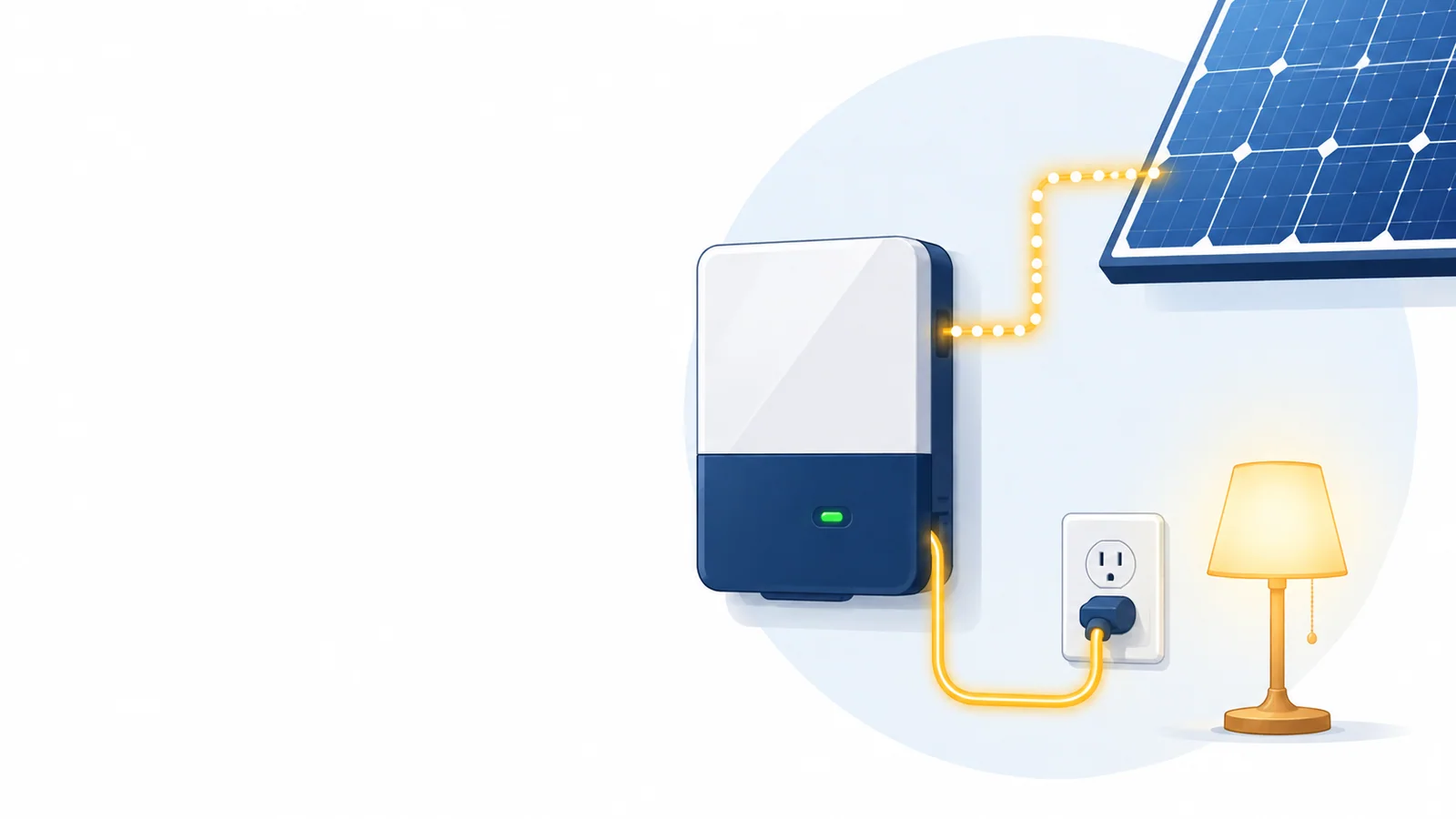
The inverter may be the least visible part of a home solar system, but it has one of the easiest jobs to explain:
The solar inverter prepares the panels' electricity for your home.
Think of it as a translator. The panels make electricity in one form. Normal home wiring and the utility grid use another form. The inverter translates between them.
That short answer is enough for most homeowners. If you want to understand what happens inside the box, keep reading.
Why does a solar system need an inverter?
Solar panels make direct-current electricity, or DC. In DC electricity, the electric charge moves in one direction.
Home circuits and the utility grid normally use alternating-current electricity, or AC. In AC electricity, the direction changes back and forth.
The inverter changes the panel's DC electricity into AC electricity that can serve home circuits and connect safely with the grid.
The energy is still electricity. Its movement pattern changes.
An easy way to remember the whole path is:
Panels make it. The inverter prepares it. The home uses it.
Where does the electricity go after the inverter?
Once the inverter prepares the electricity, it enters the home's electrical system.
The flow depends on how much the panels are making and how much the home is using:
- Solar and home use match. The home uses the solar electricity.
- The home needs more. Solar supplies part, and the grid fills the gap.
- Solar makes extra. The home uses what it needs first. Extra energy can charge a compatible battery or flow to the grid.
The homeowner does not need to choose solar or grid power every few minutes. The system responds as sunlight and home use change.
What else can a solar inverter do?
The main job is preparing electricity, but many current inverters also help manage and observe the system.
Depending on the product and design, an inverter may:
- Measure how much power the system is producing.
- Report production and equipment status to an app.
- Detect a problem and show an alert.
- Coordinate with a home battery.
- Follow utility voltage and frequency requirements.
- Shut down or disconnect when a safety condition requires it.
These features vary. A proposal should identify the exact inverter model and show which monitoring and backup features are included.
Is every solar inverter the same?
No, but the basic job stays the same.
Some systems use one central inverter for a group of panels. Other systems use small inverters at individual panels. Solar-and-battery designs may use equipment built to manage both panel production and stored energy.
Homeowners do not need to pick a design by name before the roof and electrical system are studied. The useful questions are:
- How will shade or different roof faces affect this design?
- What production data will I be able to see?
- What is the inverter warranty?
- Who handles service if the inverter reports a problem?
- Is the design compatible with the battery or backup plan I want?
- Which parts of the home, if any, will work during an outage?
The best inverter is not simply the one with the longest feature list. It is the one that fits the array, roof, utility requirements, monitoring needs, service plan, and backup goal.
Does the inverter store electricity?
No.
This is a common mix-up because the inverter and battery work together in many systems.
- The panel makes electricity.
- The inverter prepares and manages electricity.
- The battery stores energy.
An inverter may direct energy toward a battery or draw energy from it later, but the stored energy lives in the battery.
What does the inverter do during a power outage?
A normal grid-connected solar inverter watches the utility grid. If the grid goes down, the solar system usually shuts down too. This prevents the home from sending electricity into lines that utility crews may be repairing.
An inverter does not automatically create backup power just because solar panels are present.
For outage operation, the home needs a system designed to separate safely from the grid and create a stable local source of electricity. This commonly includes a compatible inverter, battery, controls, and switchgear. The design may power selected essential circuits or a larger group of loads.
Backup still has limits. The inverter must be able to deliver enough power for the connected appliances, while the battery must hold enough energy for the desired runtime. A design that can start a large appliance may not be able to run it for many hours.
Read UnionGrid's Florida solar battery backup guide before comparing outage claims.
How does inverter size affect the system?
Panels have a rated power, and the inverter has a rated output. Designers compare those values because panel output changes with sunlight, temperature, orientation, and other conditions.
The largest panel number and the inverter number do not have to match exactly. A professional design models how the equipment will work together across real conditions. The proposal should state both ratings and explain any expected limit on peak output.
Avoid judging a system from one number alone. Yearly production in kWh is often more useful to a homeowner than a brief peak measured in kW.
Where is the inverter installed?
Location depends on the equipment, home, electrical layout, code requirements, and manufacturer instructions. The product must have the required clearances and environmental protection.
Ask the installer:
- Where will the equipment go?
- Will it be easy to inspect and service?
- What sound, heat, or indicator lights should I expect?
- What should remain clear around it?
- How will I shut down the system in an emergency?
The final design and permit should show the equipment location.
The one-sentence answer
If someone asks what a solar inverter does, you can answer without a physics lecture:
The inverter is the translator between the solar panels and the home.
See that step in UnionGrid's complete visual guide to how solar works. When you compare proposals, ask for the exact inverter model, warranty, monitoring features, battery compatibility, and outage capability in writing.
Sources checked
- U.S. Department of Energy: Solar Systems Integration Basics
- U.S. Department of Energy: Solar Photovoltaic System Design Basics
- U.S. Department of Energy: Solar and Resilience Basics
- Florida Power & Light: Net Metering Guidelines
Sources reviewed August 20, 2026.
Frequently asked questions
Can solar panels work without an inverter?
Panels can make direct-current electricity, but a typical grid-connected home needs an inverter to prepare that electricity for normal home wiring and the utility grid.
Does the inverter store solar energy?
No. The inverter changes and manages electricity. A battery is the equipment that stores energy for later.
Does an inverter keep solar on during an outage?
A standard grid-connected inverter normally shuts the solar system down when the grid is out. Outage operation requires equipment and controls designed to isolate the home safely; this commonly includes a compatible battery, inverter, and transfer or switchgear equipment.
How do I know how much my solar system is producing?
Many inverters report production and system status to a display, web portal, or mobile app. Ask which data the proposed system provides, who owns the account, and what happens to monitoring if internet service is down.
Related reading
How solar works
See where the inverter fits in the complete journey from sunlight to your home.
Learn moreHow do solar panels work?
Follow every part of the home solar flow in plain English.
Learn moreSolar battery backup in Florida
Learn what a properly configured battery system can power during an outage.
Learn moreGet a free quote
Compare equipment and a roof-specific solar design with UnionGrid.
Learn moreReady to talk about your project?
Tell us what you need and our team can help you take the next step with solar, roofing, battery storage, or roof-related solar work.