The short answer
- A nail pop is a shingle nail backing out of the deck. It can puncture the shingle above and keep it from sealing.
- Caulk over the bump leaves the loose nail in place. A proper repair replaces the nail and hand-seals the shingle.
- Pops across the roof, or on a roof only a few years old, point to the deck, nail length or attic ventilation.
In this guide
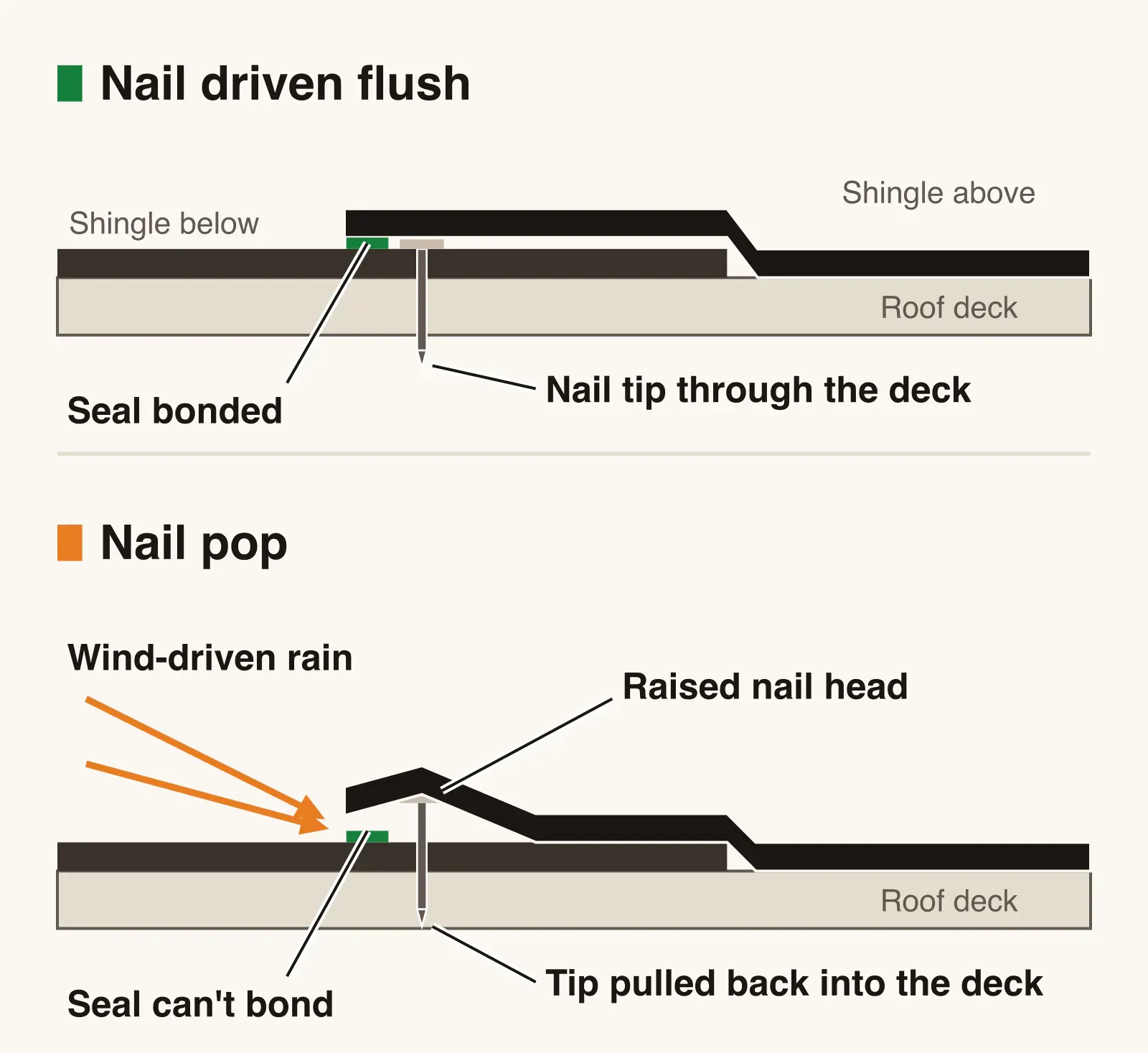
A small, tent-shaped bump in a shingle that should lie flat is the classic sign of a roof nail pop, a nail that has backed partway out of the wood deck and is pushing up the shingle over it. A dab of caulk hides the bump, but the loose nail stays put, and the shingle above it may never seal down again.
In Florida, that seal is the part worth protecting. University of Florida engineers who studied shingle roofs here describe the adhesive strip along each shingle's edge as the main thing holding it down in wind.
One pop on an older roof is a small repair. Pops spread across the roof, or on a roof only a few years old, point to the deck and the attic.
What does a nail pop look like?
The Journal of Light Construction describes a nail pop as a tent-shaped blister in the shingles, caused by a nail pushing up from below. The culprit can be one of the four or more nails that hold each shingle, a nail from the plywood or OSB deck underneath, or one left behind when a new roof went on over an old one.
Long, wavy ridges along the deck seams point to buckled sheathing instead, covered below. Look from the ground or with binoculars, and stay off the roof.
What causes roof nail pops?
The causes come down to a nail that never got a firm grip in the wood, or a deck that keeps moving around it:
- Nails too short. As of Nov. 6, 2026, Florida's residential building code (8th Edition, 2023) requires shingle nails to reach at least 3/4 inch into the roof sheathing, or to go all the way through sheathing thinner than that. The Asphalt Roofing Manufacturers Association (ARMA) asks for at least 1/8 inch through a thin deck, and Owens Corning's July 2026 instructions for its Duration shingles ask for 1/4 inch.
- Nails left high. GAF's installation instructions say nails must be driven flush and warn that "raised fasteners will interfere with the sealing of the shingles and can back out." ARMA ties badly adjusted nail guns to sealing failures, raised tabs and blow-offs.
- A deck that swells and shrinks. Plywood and OSB grow and shrink with moisture, which is why APA, the engineered wood trade group, says to leave 1/8 inch between sheathing panels. Panels butted tight, or decking that got wet before the shingles went on, can work nails loose as they move.
- A hot, poorly vented attic. In a Florida Solar Energy Center study of homes in Fort Myers, the attic under a dark shingle roof hit 135.6 degrees in July 2000 and ran 40 degrees hotter than the outdoor air at the peak hour. Blocked soffit vents and weak ridge venting trap that heat and moisture against the deck, construction-defects architect Harrison McCampbell wrote in JLC.
Why do roof nail pops matter in a Florida storm?
Each shingle has a heat-activated sealant strip that bonds it to the row below. The UF researchers, writing in 2013, called that strip the main load path resisting wind uplift. When part of it lets go, wind forced into the gap raises the pressure under the shingle and makes a blow-off more likely.
A popped nail works against that bond. On most shingles with the sealant on top, ARMA puts the nail just below that strip, under the edge of the next row, so a raised head sits right where the shingle above needs to stick. A loose nail can also punch through that shingle, which Fine Homebuilding lists as a direct cause of leaks.
The wind rating on a shingle bundle assumes the shingles are sealed. The UF paper notes that ASTM D7158 wind classes apply only to fully sealed shingles. On 27 Florida homes the team checked, 70% of the roofs showed patterns of partly unsealed shingles. Older roofs had more of them, and the pattern resembled wind damage in post-hurricane reports.
Hurricane season runs June 1 to Nov. 30, according to the National Hurricane Center. The months in between give time to have pops fixed before the next one.
What does a proper nail pop repair include?
Caulk on the nail head covers the symptom. The nail stays loose, and nothing holds down the edge of the shingle above. ARMA's remedy for a badly driven nail, plus the shingle makers' sealing rules, looks like this:
- Lift the shingle above with care and pull the loose nail.
- Fill the old hole with asphalt roof cement that meets ASTM D4586.
- Drive a new nail nearby, flush, into solid wood, long enough to meet the 3/4-inch rule.
- Hand-seal the lifted shingle. GAF's instructions call for four quarter-sized dabs of adhesive on its shingles and warn that cement thicker than 1/8 inch can blister them. UF researchers advise the same for loose edges.
- Replace any shingle the nail tore or cracked. ARMA names replacement as the fallback when re-nailing is not practical.
Ask for those steps in the written scope, and check that the paperwork names who holds the roofing license for the job.
When do several nail pops point to a deck or attic problem?
There is no set number. The pattern tells you more than the count:
| What you see | What to ask about |
|---|---|
| One or two pops on an older roof | A spot repair |
| Pops on a roof only a few years old | Nail placement and length; Fine Homebuilding treats pops on a new roof as a sign of sloppy installation |
| Pops across the roof, or back after a repair | A deck that keeps moving, or nails too short for it |
| Wavy lines along sheathing seams | Panels installed without expansion gaps |
| Hot, stuffy attic or damp sheathing | Whether the vents meet Florida's code minimum |
Florida's code sets attic vent area at 1/150 of the vented space, or 1/300 when 40% to 50% of that vent area sits high, within 3 feet of the ridge.
A flashlight at the attic hatch helps. On a deck thinner than 3/4 inch, nails of the right length poke through the underside, ARMA notes, so long stretches of bare wood suggest short nails. Look for stained sheathing and insulation pushed against soffit vents, and step only on framing.
Deck or vent work is a bigger job than resetting nails, and permit rules depend on the city or county. Our Pensacola permits guide shows how that gets decided.
Photograph the raised spots from the ground, note the roof's age and any attic stains, then request a roof repair assessment in Tampa or through the Brandon, Riverview or Pensacola pages.
Sources checked
- Florida Building Code, Residential, 8th Edition (2023), Chapter 9: asphalt shingle fasteners (R905.2.5, R905.2.6)
- Florida Building Code, Residential, 8th Edition (2023), Chapter 8: attic ventilation (R806)
- NOAA National Hurricane Center: Atlantic hurricane season dates
- Florida Solar Energy Center: roofing systems and attic temperatures in Fort Myers homes
- University of Florida: The Unsealing of Naturally Aged Asphalt Shingles (2013)
- University of Florida: researchers identify ways to prevent shingle blow-off in hurricanes
- Asphalt Roofing Manufacturers Association: Nail Application of Asphalt Shingles (July 2024)
- GAF: Timberline HDZ installation instructions
- Owens Corning: Duration Series shingles installation instructions (July 2026)
- APA: Prevent Buckling with Proper Spacing
- Journal of Light Construction: Nail Pops in Roof Shingles
- Fine Homebuilding: 10 Roof Goofs and How to Fix Them
Sources reviewed Nov. 6, 2026.