The short answer
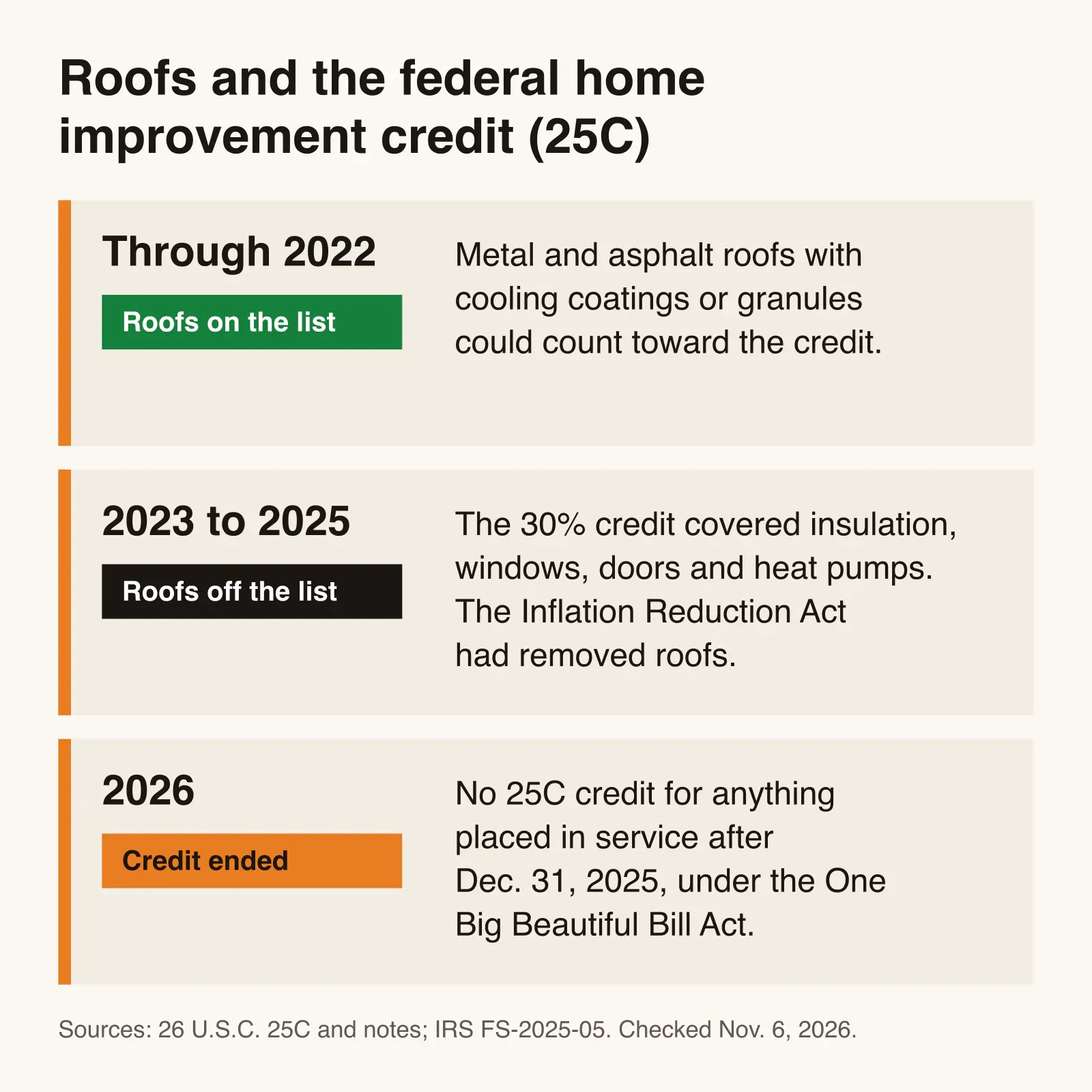
- As of Nov. 6, 2026, no federal tax credit covers a new roof; the Section 25C credit ended for property placed in service after Dec. 31, 2025.
- Roofs were cut from that credit after 2022, so roofs installed in 2023, 2024 or 2025 did not qualify either.
- A roof can still matter as a home-basis improvement, rental depreciation or a declared-disaster casualty loss.
- In Florida, check wind mitigation insurance discounts and My Safe Florida Home grants instead.
In this guide
No. As of Nov. 6, 2026, there is no federal tax credit for a new roof. The 30% Energy Efficient Home Improvement Credit, Section 25C of the tax code, ended for anything placed in service after Dec. 31, 2025, and roofs were cut from it three years before that.
Ads that still quote "30%" or "$3,200" describe a credit that, in its last three years, paid toward insulation, windows, doors and heat pumps. A 2026 roof can still matter on a tax return in other ways, and Florida has two programs worth a look.
None of this is tax advice. Confirm your own case with a tax professional.
Is there a tax credit for a new roof in 2026?
Not a federal one. The One Big Beautiful Bill Act, signed July 4, 2025, as Public Law 119-21, moved the credit's end date from 2032 to property placed in service after Dec. 31, 2025, in Section 70505.
"The credit will not be allowed for any property placed in service after December 31, 2025," the IRS says in its FAQ on the law, FS-2025-05.
The solar credit, Section 25D, ended for expenditures made after Dec. 31, 2025, too. It covered solar shingles that make electricity, but generally not ordinary roofing. The Florida solar incentives guide covers what is left on the solar side.
Did roofs qualify in 2023, 2024 or 2025?
No. The Inflation Reduction Act struck "any metal roof or asphalt roof" with cooling coatings or granules from the credit's list for property placed in service after Dec. 31, 2022.
The IRS later corrected its 2023 Form 1040 instructions, which still listed those roofs. "These types of roofs no longer qualify for the energy efficient home improvement credit," the correction says.
From then on, the list covered insulation and air sealing, exterior windows and skylights, and exterior doors. The IRS's 2025 Form 5695 instructions add that a part providing "structural support or a finished surface" does not count as one designed to cut heat loss or gain.
The $3,200 in those ads was never roof money. The IRS describes it as the most one taxpayer could claim in a year, with up to $1,200 for envelope items and some equipment plus up to $2,000 for heat pumps and a few other systems.
What if your roof went on in 2025?
The roof covering still would not count on a 2025 return.
Insulation or air sealing added in the same job is a different line. If it met the IECC energy code criteria, went into the main home you own and was finished by Dec. 31, 2025, it could have qualified for 30% of its cost, up to $1,200. A return that is already filed is changed on Form 1040-X; a tax professional can say whether that is worth doing.
Can you claim a new roof on taxes another way?
Sometimes, as a basis adjustment or a deduction rather than a credit. These are the rules in the IRS's 2025 publications.
| Your situation | What the IRS says |
|---|---|
| Your main home | A new roof is an improvement that adds to your home's basis (Publication 523), which means a smaller gain when you sell. |
| A rental you don't live in | Capitalize the roof and depreciate it over 27.5 years (Publication 527). Landlords could never use 25C on those homes. |
| Storm or hurricane damage | A personal casualty loss counts only if it comes from a federally declared disaster (Publication 547). Starting in 2026, certain state-declared disasters count too, the IRS says. |
For a casualty loss, the IRS starts with the smaller of your adjusted basis or the drop in the home's value. It subtracts insurance, then takes off $100 per casualty and 10% of adjusted gross income. File the insurance claim on time, because Publication 547 says skipping it limits the deduction.
Hurricane Isaias falls under that rule for much of the Panhandle and Big Bend. The IRS's Oct. 14, 2026, release, FL-2026-07, gives people in Escambia, Santa Rosa, Okaloosa, Leon and the other listed counties until Feb. 8, 2027, for many federal filings and payments, and lets them claim the loss on the 2026 or 2025 return.
What Florida help exists for a new roof?
Florida has two programs that can reward a stronger roof, and neither of them is a tax credit.
The first is an insurance discount. Section 627.0629 of the Florida Statutes says a residential property insurance rate filing "must include actuarially reasonable discounts, credits, or other rate differentials" for features that reduce windstorm loss, such as roof strength and roof-to-wall strength.
An authorized inspector records those features on form OIR-B1-1802, which the Office of Insurance Regulation says stays valid for up to five years if no material changes are made to the structure. After a reroof, ask your insurer whether it wants a new one.
The second is My Safe Florida Home, run by the Florida Department of Financial Services. It can fund "replacing the roof covering" and stronger roof-to-wall connections when the program's own inspection recommends them.
State law caps the state share at $10,000 and asks $1 from the homeowner for every $2 from the state, with no match for low-income applicants. Grants are limited to homesteaded homes built before Jan. 1, 2008, with an insured value of $700,000 or less, and to low- or moderate-income applicants.
The program's support center says it "is now accepting applications," in an article last updated Aug. 17, 2026. Funding is "subject to annual legislative appropriations," so confirm it before you plan a roof around a grant.
What your answer depends on
- Whether the house is your main home, a rental or both.
- Whether the damage came from a declared disaster, and in which year.
- How much insurance paid.
- How the invoice splits the roof covering, decking, underlayment and any insulation.
Get the roof scope in writing first
Ask for an itemized roof scope before you see a tax professional or apply for a grant. Start with a Tampa roof replacement assessment; the project documents should name the appropriately licensed roofing party for the roof work. The roof replacement cost guide shows which lines a useful estimate breaks out.
Sources checked
- IRS: Energy Efficient Home Improvement Credit
- IRS: FS-2025-05, FAQs on 25C and 25D
- IRS: Instructions for Form 5695 (2025)
- IRS: Correction to 2023 Form 1040 instructions
- IRS: Energy credit FAQs, FS-2025-01
- Public Law 119-21
- 26 U.S.C. 25C (Cornell LII)
- IRS Publication 523, Selling Your Home
- IRS Publication 527, Residential Rental Property
- IRS Publication 547, Casualties, Disasters, and Thefts
- IRS: Casualty loss deduction expanded and made permanent
- IRS: Hurricane Isaias relief, FL-2026-07
- IRS: Amended return FAQs (Form 1040-X)
- Florida Statutes section 627.0629
- Florida OIR: wind mitigation resources
- Florida Statutes section 215.5586
- My Safe Florida Home: Is funding currently available?
Tax, insurance and grant references checked Nov. 6, 2026.