
solar panels cloudy days
Do Solar Panels Work on Cloudy Days, at Night, or During Outages in Florida?
By UnionGrid Team7 min read
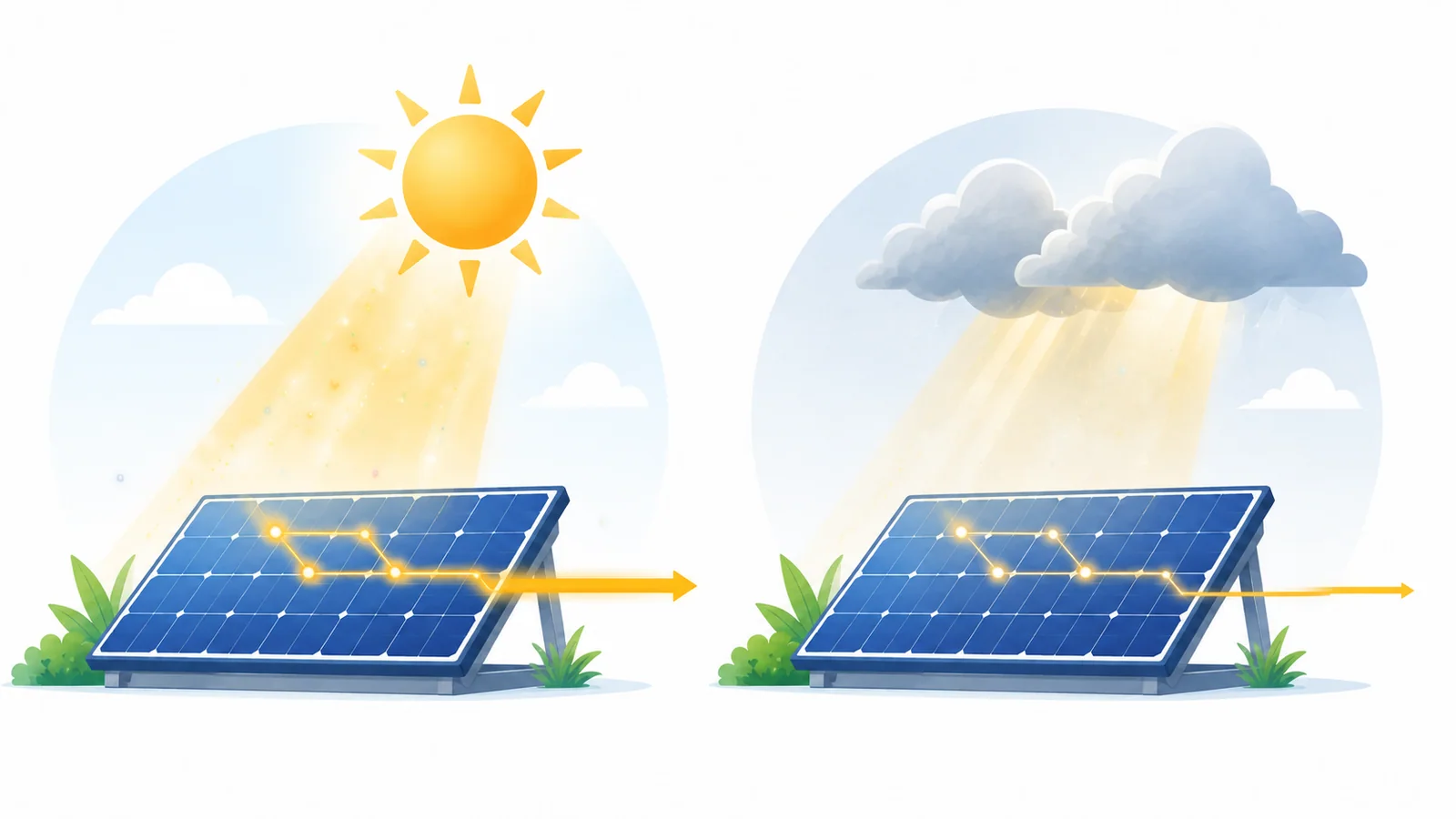
Florida weather can move from bright sun to dark clouds in one afternoon. That leads to four common homeowner questions:
- Do solar panels work on cloudy days?
- Do they work in the rain?
- Do they work at night?
- Do they keep the house on during a power outage?
The short answers are:
| Condition | What rooftop solar does |
|---|---|
| Bright sun | Usually produces more electricity |
| Clouds or rain | Can keep producing, usually at a lower level |
| Night | Produces no solar electricity |
| Grid outage | Usually shuts down unless the system is designed for safe backup |
The details matter, especially if a proposal makes a perfect-weather or unlimited-backup promise.
Why sunlight changes solar production
Solar cells absorb energy from light and use it to create moving electrical charges. The amount of useful light reaching the panel therefore affects how much electricity it can make.
Light changes throughout the day. The Sun is low in the morning, higher near midday, and low again before sunset. The season, local weather, shade, panel direction, and roof angle also change the solar energy available.
Production is a curve, not an on/off block. It normally grows after sunrise, reaches a stronger period during the day, and falls toward sunset.
Do solar panels work on cloudy days in Florida?
Yes.
Clouds scatter, absorb, and block some sunlight, but they do not always stop all light from reaching the roof. Solar panels can use the light that arrives, including diffuse light from the sky.
Output is usually lower under thick cloud cover than under bright, direct sun. There is no one cloud percentage that applies to every home or storm. The result depends on:
- How thick and widespread the clouds are.
- The time of day.
- Shade from trees or nearby structures.
- Roof direction and slope.
- Panel and inverter characteristics.
- Temperature and system condition.
The right way to estimate yearly solar production is to use local weather data across many days, not to multiply one perfect sunny hour across the year.
What happens when it rains?
Panels can keep producing while it rains if light still reaches them. Heavy storm clouds usually reduce output, sometimes substantially.
Rain itself is not a source of solar energy. The useful input is still light.
Homeowners also should not assume rain replaces every maintenance or inspection need. Debris, leaves, bird droppings, shade growth, roof drainage, and equipment condition are separate issues. Follow the equipment and installer's maintenance guidance rather than using a fixed cleaning schedule for every roof.
Does Florida heat improve solar production?
Sunlight and heat are not the same thing.
Bright sunlight gives solar cells more light energy to work with. But as the solar cells become hotter, their electrical efficiency can decrease slightly. The U.S. Department of Energy explains that higher temperature can lower cell voltage more than it raises current.
That does not mean solar stops making sense in a warm climate. It means a realistic model uses the equipment's temperature behavior and local conditions. “Florida is hot, so production is unlimited” and “heat makes solar useless” are both poor explanations.
Do solar panels work at night?
No.
Once sunlight is gone, rooftop panels stop producing electricity. A panel does not store the energy it made during the day.
At night, one or both of these sources serve the home:
- Battery: stored energy, when a charged battery is installed and configured to serve the load.
- Grid: utility electricity.
The transition is normally automatic. The homeowner does not need to switch the house from solar to grid every evening.
What happens around sunset?
Evening is often a useful time to compare production and use.
Solar output falls as the light fades. At the same time, the home may still be using air conditioning, cooking equipment, lights, electronics, and hot water.
If production is lower than home use, a battery can provide part or all of the difference within its limits. The grid supplies what the solar-and-battery system does not provide.
Battery runtime depends on usable energy in kWh, available power in kW, state of charge, reserve settings, conversion losses, and the appliances running. Read the simple kW vs. kWh guide before comparing runtime claims.
Do solar panels work during a Florida power outage?
Panels alone usually do not keep a grid-connected home powered during an outage.
Standard solar equipment detects the loss of the grid and shuts down. This prevents electricity from feeding into power lines while utility workers may be repairing them.
For a home to use solar during an outage, the system must be designed to:
- Disconnect safely from the utility grid.
- Create a stable source of electricity for the home.
- Balance changing solar production with the loads being served.
This commonly requires a compatible inverter, battery, controls, and switchgear. The exact equipment and approved design matter.
What can a solar battery run during an outage?
A battery can power only what the complete system is designed to support.
A selected-load design may serve essentials such as:
- A refrigerator.
- A few lights and outlets.
- Internet equipment.
- Phone charging.
- Fans.
- A garage door or well pump when properly sized.
Large loads change the design quickly. Central air conditioning, electric water heating, electric cooking, dryers, and pool equipment can require high startup power and use stored energy much faster.
Ask for a written list of backed-up circuits and a load-based runtime estimate. “Whole-home backup” should come with specific power, capacity, control, and operating assumptions.
Can solar recharge a battery during a multi-day outage?
It can when the system is designed for solar charging while safely isolated from the grid.
During available sun, the panels may serve home loads and send extra energy to the battery. After solar production falls, the battery can serve selected loads.
That daily rhythm can extend backup, but it is not unlimited. Cloud cover, shade, household use, battery settings, equipment limits, and the battery's starting charge all affect the result. A full recharge every day is not guaranteed.
How should a Florida production estimate handle weather?
A useful proposal should show estimated energy production in kWh by month and year. Ask which weather source, shade model, equipment losses, and roof details were used.
Compare that estimate with at least 12 months of documented home electricity use. One low-use winter bill or one bright screenshot does not describe the year.
Also ask:
- What production guarantee, if any, is written into the contract?
- What happens if a tree grows or a new structure creates shade?
- How will I monitor actual production?
- Which equipment warranty covers the panels and inverter?
- Does the outage design recharge from solar while islanded?
- Which circuits are backed up, and what runtime assumptions were used?
The simple ending
Solar follows the light:
Sun means production. Clouds usually mean less. Night means none.
Backup follows the design:
Panels alone usually shut down. Compatible solar plus storage can power selected loads when the system is built for it.
See the full day-to-night flow in UnionGrid's visual guide to how solar works. For a roof-specific production and backup discussion, request a free quote and bring your last 12 months of electricity use plus a list of the appliances that matter most during an outage.
Sources checked
- U.S. Department of Energy: Solar Radiation Basics
- U.S. Department of Energy: Solar Photovoltaic Performance and Efficiency Basics
- U.S. Department of Energy: Solar and Resilience Basics
- U.S. Department of Energy: Homeowner's Guide to Solar
- Florida Power & Light: Net Metering Guidelines
Sources reviewed August 20, 2026.
Frequently asked questions
Do solar panels work on cloudy days in Florida?
Yes. Some sunlight still reaches the panels, so they can keep producing. Output is usually lower than under bright, direct sun, and the amount changes with the clouds, shade, equipment, and time of day.
Do solar panels work at night?
No. Panels need light to produce electricity. At night, the home uses stored battery energy when available and configured, or electricity from the grid.
Does Florida heat make solar panels work better?
Bright sunlight supports production, but higher solar-cell temperatures can reduce electrical efficiency slightly. A useful production model accounts for both local sunlight and temperature.
Will solar panels power my home during a grid outage?
Panels alone usually shut down with the grid for utility-worker safety. Outage power requires a system designed to isolate the home safely, commonly with a compatible inverter, battery, controls, and switchgear. The design determines which loads can run and for how long.
Related reading
See solar move from day to night
Follow the full visual journey through panels, a battery, the home, and grid.
Learn moreFlorida solar battery backup
Learn what selected-load and larger backup designs can actually cover.
Learn moreHow do solar panels work?
Read the simple explanation of how light becomes home electricity.
Learn moreGet a free quote
Ask for production and backup estimates based on your own home.
Learn moreReady to talk about your project?
Tell us what you need and our team can help you take the next step with solar, roofing, battery storage, or roof-related solar work.