The short answer
- Florida law makes insurers include wind mitigation discounts, credits or lower deductibles in their rates; a current form on file is what gets them applied.
- Inspections on or after April 1, 2026, use the revised OIR-B1-1802, valid for up to five years if the house does not change in a material way.
- A new roof usually means a new inspection, so collect the permit, product approval number and deck photos before the roof is closed up.
- As of Nov. 6, 2026, My Safe Florida Home lists free inspections and grants of up to $10,000 for eligible homeowners.
In this guide
Under Section 627.0629 of the Florida Statutes, every home insurer's rates must include discounts, credits or lower deductibles for wind-resistant homes. Your insurer applies them only when a current wind mitigation form on file shows what your house has.
That form is the state's OIR-B1-1802. It was revised for inspections on or after April 1, 2026, and a completed one is good for up to five years unless the house changes in a material way, and a new roof can be that change. The rules below were checked as of Nov. 6, 2026.
What Florida law makes your insurer do
A residential rate filing "must include actuarially reasonable discounts, credits, or other rate differentials, or appropriate reductions in deductibles" for homes where wind-loss features "have been installed or implemented," the statute says.
Section 627.711 adds a notice. Your insurer must tell you the available mitigation credits and their range when the policy is issued and again at each renewal, on the state's form OIR-B1-1655. Since Oct. 1, 2023, insurers have also had to list these hurricane discounts on their websites.
No dollar figure is promised. The form warns that "some items listed may not qualify for a discount," and an insurer may pay for its own check of a form before accepting it.
The law makes the credit available, but your form is what gets it applied.
What Florida's 2026 wind mitigation form checks
The 2026 version asks nine questions, up from seven on the 2012 form. Each feature claimed in questions 2 through 9 needs at least one photo or document, and a FORTIFIED Home certificate can now back up several of them.
Scroll to compare all columns
| # | Question | What the inspector records | Can a new roof change it? |
|---|---|---|---|
| 1 | Building code | The Florida Building Code in force when the home was first permitted | No |
| 2 | Region (new) | Design wind speed zone, from the HVHZ to Region 3 (under 130 mph) | No |
| 3 | Roof slope (new) | 6:12 or steeper, or flatter | No |
| 4 | Roof covering | Type, permit date or product approval number, year installed | Yes |
| 5 | Roof deck attachment | The weakest nailing of the plywood or OSB deck | Yes, if the deck is re-nailed |
| 6 | Roof-to-wall attachment | The weakest truss or rafter connection | Sometimes |
| 7 | Roof geometry | Hip roof, or another shape | No |
| 8 | Sealed roof deck | Taped seams, self-adhered underlayment, double felt or spray foam; standard felt does not count | Yes |
| 9 | Opening protection | The weakest protected opening, garage door included | No |
Citizens Property Insurance Corp. tells agents that roof slope does not change its credits, and that many of these features are already in its base rate for homes built in 2002 or later.
Do hurricane clips count? What the form says about trusses
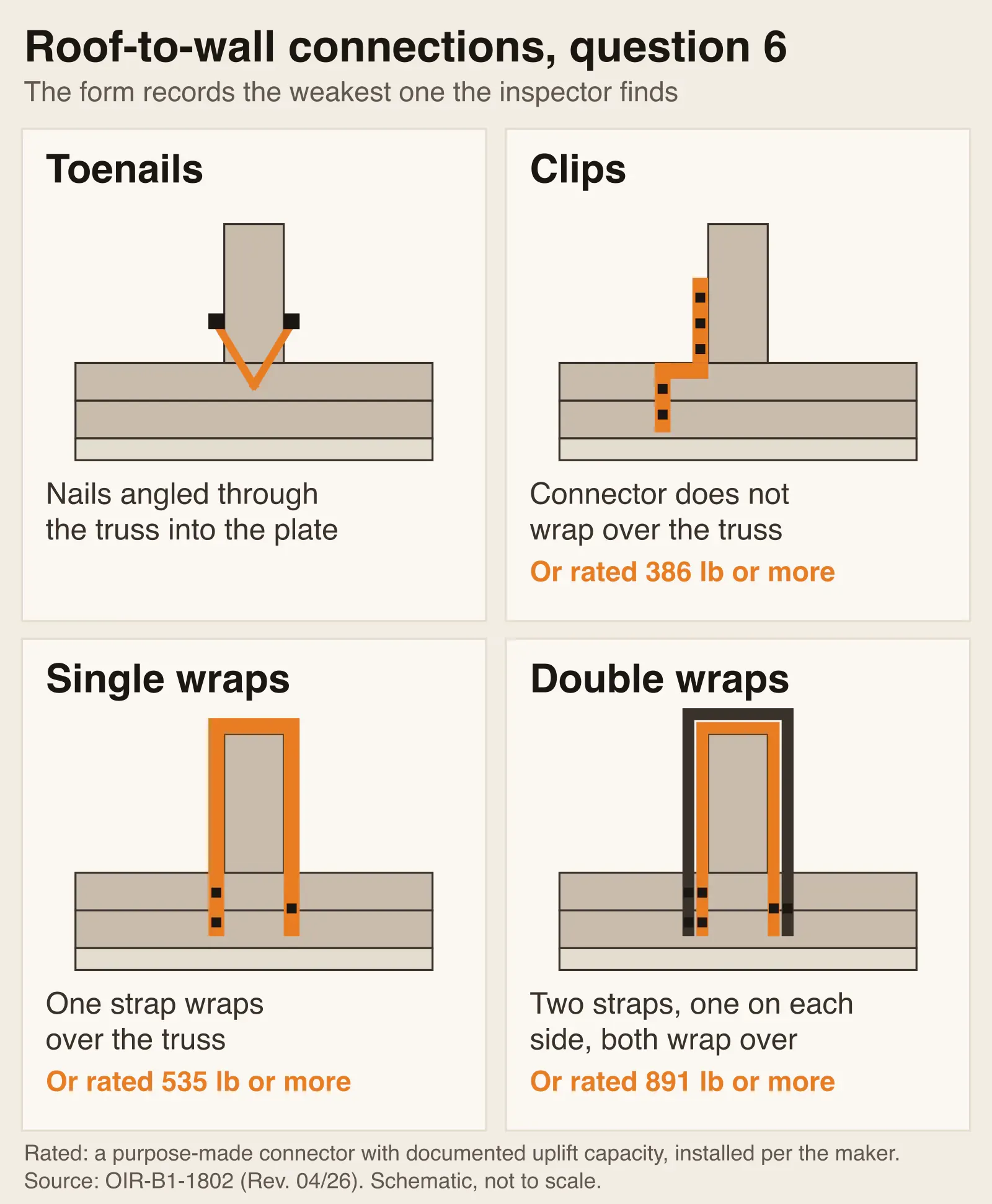
Question 6 records the weakest roof-to-wall connection the inspector can find, usually from the attic. The answers climb from toenails to clips, single wraps, double wraps and structural ties such as anchor bolts.
The 2026 form adds a second route for purpose-made connectors. If one is installed to the maker's specs, with paperwork for the house, a documented uplift rating of at least 386 pounds counts as a clip, 535 pounds as a single wrap and 891 pounds as a double wrap.
Keep the product sheets and installer records for any retrofit. Chris Rizer, a Simpson Strong-Tie branch engineer, wrote in June 2026 that retrofit hardware may not be visible to the next inspector.
Who can sign a wind mitigation form in Florida?
Under Section 627.711(2)(a), an insurer "shall accept as valid" a form signed by any of these:
- a licensed home inspector with at least 3 hours of approved hurricane mitigation training and a proficiency exam
- a certified building code inspector
- a licensed general, building or residential contractor
- a licensed professional engineer or architect
- anyone else the insurer recognizes as qualified
The signer must inspect the house in person, though contractors and engineers may send their own employee. Citizens grants no credit on a form from an unqualified or unlicensed inspector, so look the license up on the state's DBPR search first.
Hire one of the professionals the statute lists to do the inspection and sign the form.
Does a new roof mean a new wind mitigation inspection?
In most cases, yes. The five-year clock holds only if "no material changes have been made to the structure," and a reroof changes at least the roof covering answer.
Under Section 553.844, building code rules require a roof replacement on a site-built single-family home to add a secondary water barrier and stronger roof-deck attachment. In the wind-borne debris region, a home insured for $300,000 or more must also get roof-to-wall connections, but only if the work at gable ends or all corners fits within 15% of the reroof cost.
Those features sit behind questions 5, 6 and 8, and most end up hidden; Citizens notes that a secondary water barrier "is generally not visible on completed roofs." Ask the roofer, before work starts, to hand over:
- the permit and the product approval number
- photos of the deck nailing and the sealed deck
- product sheets for any new clips or straps
Book the inspection after the final roof inspection and send the new form to your agent. The form is not a roof-condition report, and Citizens says it "is not acceptable proof of roof condition or replacement."
Pricing a roof replacement in Tampa? The project documents should name the appropriately licensed roofing party, with that paperwork in the scope. If panels go back on, the hurricane-rated mounting guide covers the racking.
Is My Safe Florida Home still giving free inspections?
As of Nov. 6, 2026, the program's official site says free wind mitigation inspections and grants of up to $10,000 are available. The state's Department of Financial Services runs it on yearly funding, and the law says no one is entitled to it.
An inspection requires a site-built, owner-occupied single-family home on its own parcel with a homestead exemption. A grant also requires an insured value of $700,000 or less, a home built before Jan. 1, 2008, and low or moderate household income. The state pays $2 for every $1 you put in, up to $10,000; low-income homeowners need no match.
The program assigns its own inspector, and it "no longer maintains a list of authorized contractors," so checking a contractor's license falls to you. Starting work before grant approval disqualifies the reimbursement.
Check your discount before the next renewal
- Find your current form and note its date and version, Rev. 01/12 or Rev. 04/26.
- Read the mitigation notice that comes with your renewal.
- If the form is more than five years old, or the roof was replaced since, book a new inspection.
- Send it to your agent and ask which credits were applied.
Citizens said in March 2026 it will keep accepting a Rev. 01/12 form done in the five years before April 1, 2026 if nothing structural changed, and its guide allows a form signed by a prior owner. Ask other insurers what they take.
If the roof is due anyway, bring that paperwork list to a roofing estimate so the next inspector can verify what went in.
Sources checked
- Section 627.0629, Florida Statutes
- Section 627.711, Florida Statutes
- Section 553.844, Florida Statutes
- Section 215.5586, Florida Statutes
- OIR: form OIR-B1-1802 (Rev. 04/26)
- OIR: Wind Mitigation Resources
- My Safe Florida Home and FAQs
- Citizens: form changes, March 19, 2026
- Citizens: Wind Loss Mitigation Guide
- Simpson Strong-Tie: the Rev. 04/26 form
- Florida DBPR license search
Sources reviewed Nov. 6, 2026.