The short answer
- A new home can be made solar ready during the build, years before panels go on.
- DOE's PV-Ready Checklist calls for a marked roof zone, roof load ratings, 1-inch conduit to the panel and a reserved breaker space.
- NREL says to pick a roof that lasts at least as long as the panels and to check the roof warranty's terms on solar.
- As of Nov. 12, 2026, Florida's new code section on solar-ready homes applies only where a builder provides a solar-ready zone.
In this guide
A new Florida home can be built ready for solar panels years before any panel goes on the roof. Most of the work is a few lines on the plans and one run of pipe, and it has to happen while the framing is still open.
Two federal documents spell it out. The U.S. Department of Energy's PV-Ready Checklist, seven items long and dated Oct. 1, 2024, applies to homes certified under its Zero Energy Ready Home program. The National Renewable Energy Laboratory's Solar Ready Buildings Planning Guide, from December 2009, gives the reasons. For a buyer weighing solar panels for new homes, they come down to five things to settle with the builder.
The code and law references below are as of Nov. 12, 2026.
Why plan for solar before the walls close?
Skip the planning and solar "may not be technically possible," NREL's guide warns, or the cost of changing the house later may rule it out.
Wiring is the clearest case. Conduit run through floors, ceilings and walls during construction "will be much easier than doing it after the building is complete," the guide says.
DOE's checklist sets the deadline. Any item that drywall will hide has to be verified at the pre-drywall inspection.
What makes a new home solar ready?
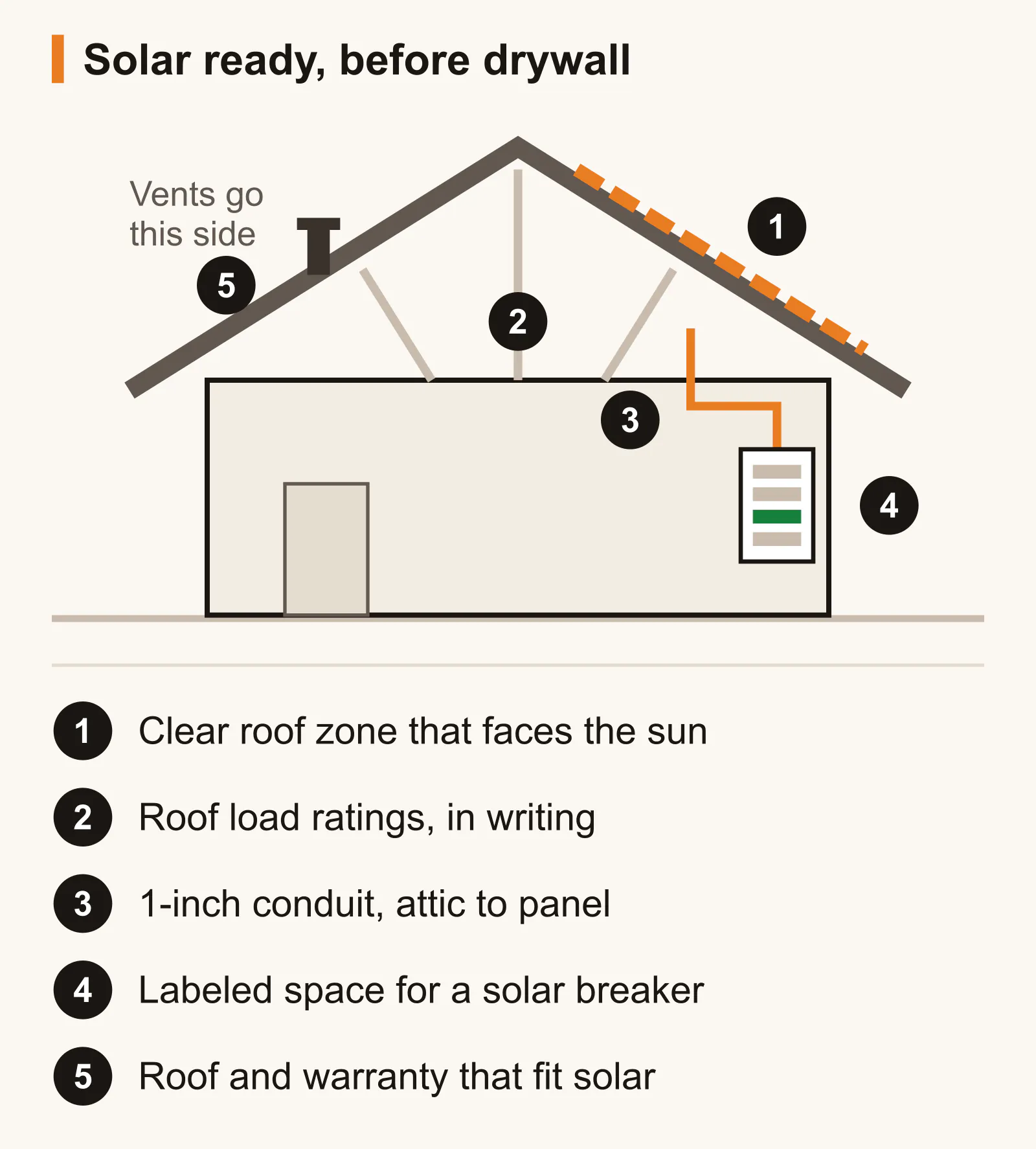
1. Mark a clear zone on the roof
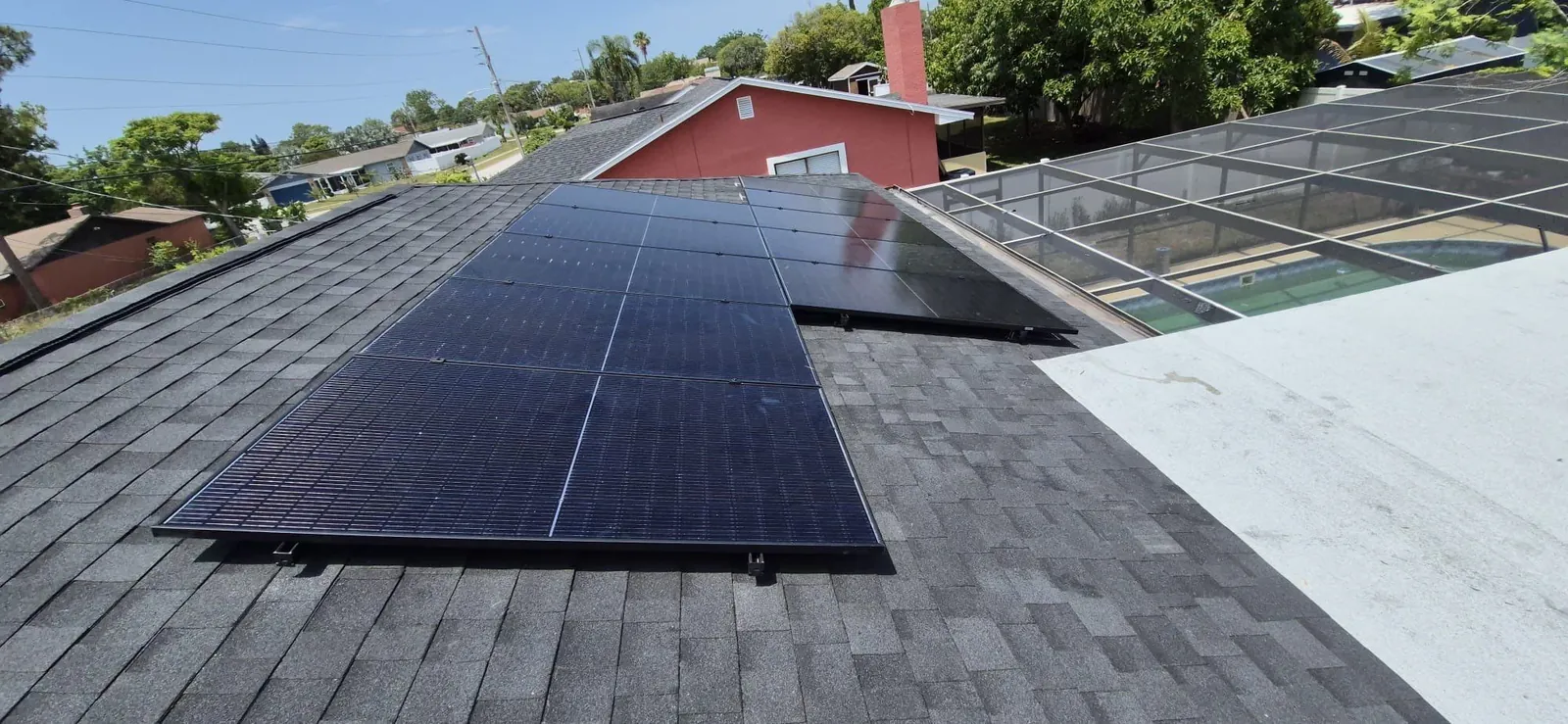
DOE asks the builder to mark a proposed array location on the plans, with its square footage, facing between 110 and 270 degrees of true north. On a compass, that arc runs from east-southeast through south to due west.
Then keep it clear. NREL's guide puts vents and mechanical equipment on the north side of the roof. It calls solar panels "exceptionally susceptible to shading," most of all between 10 a.m. and 2 p.m., and that goes for the trees in the landscape plan too.
2. Get the roof's load ratings in writing
Panels and racking add about 3 pounds for each square foot of array, by NREL's figure. DOE's checklist has the builder give the owner documentation of the roof's maximum allowable dead load and live load ratings. File it with the house plans.
3. Run the conduit
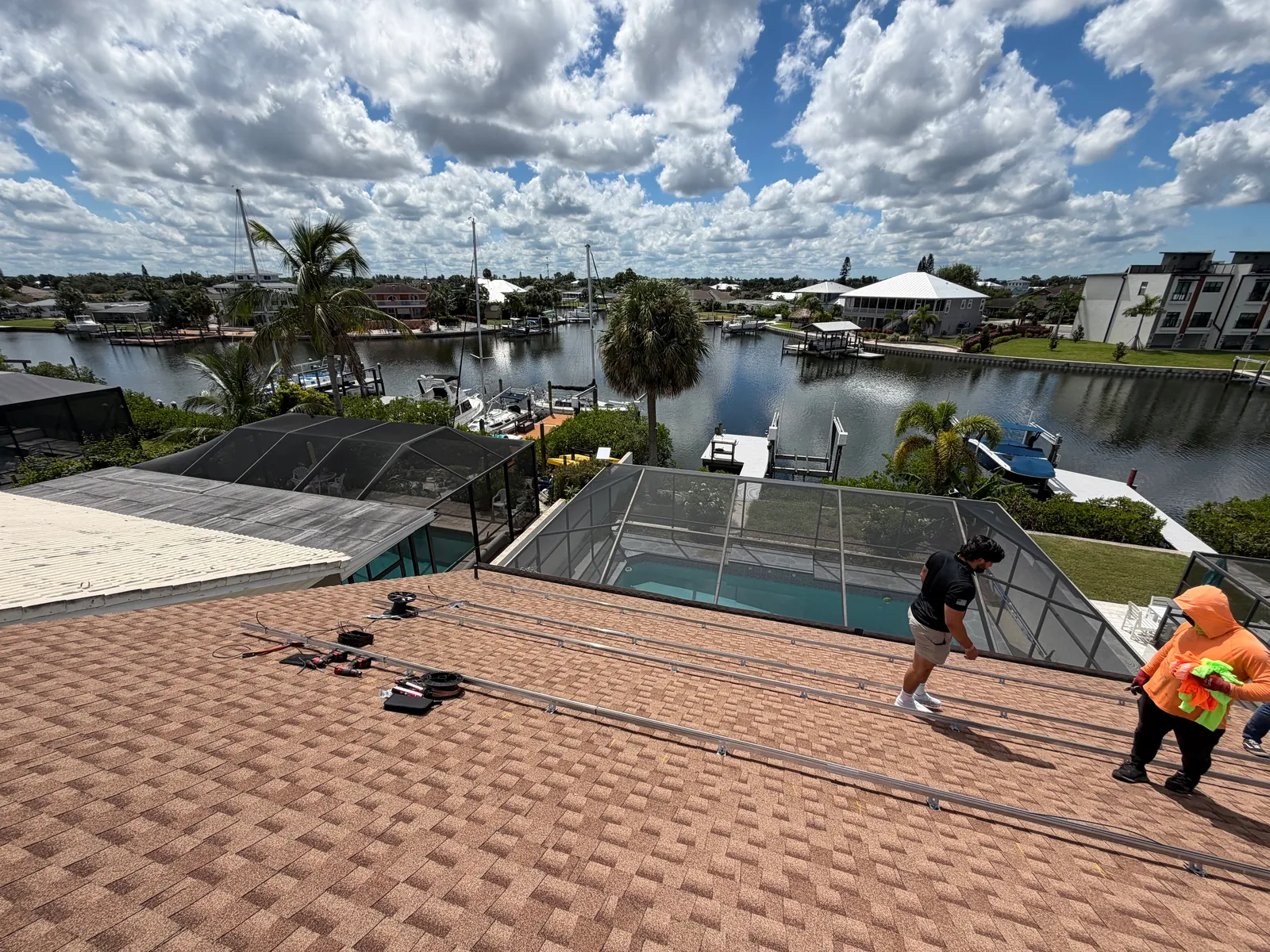
This is the item drywall hides. DOE calls for 1-inch conduit from the attic space under the array location to a junction box within 8 feet of the main electrical panel, capped and labeled at both ends.
4. Save a slot in the electrical panel
The checklist reserves space in the panel for a two-pole breaker for the future solar system, and the panel gets a label saying so.
NREL adds a sizing point. As its guide describes the electrical code, solar and grid power together cannot exceed 120% of the panel's rating, so ask the electrician to size the panel with solar in mind. The guide also says to leave room near the panel for an inverter and to decide early whether storage is needed. If backup power is on your list, our guide to how kW and kWh size a battery is worth reading before the electrical plan is final.
5. Pick a roof that outlasts the panels
"Solar PV panels often have a 25-year warranty," the NREL guide says. "It is important to install a roof that will last at least as long."
The guide also warns that roof penetrations "may void the roof warranty" and tells owners to check whether the warranty has terms about solar. Ask for those terms before the roofing is ordered. Our guide to what solar and installation warranties cover explains the solar side.
Does Florida require solar panels on new homes?
Not in the state's new code section on solar-ready homes, which applies only where a builder provides a solar-ready zone.
The 9th Edition of the Florida Building Code takes effect Dec. 31, 2026, according to the Florida Building Commission's work plan. Its energy volume adds section R103.2.2, "Solar-ready system." The commission's analysis of the changes says the section "stipulates construction document details required where a solar-ready zone is provided."
One city went further. South Miami's commission voted 4-1 in 2017 to require solar panels on new single-family homes, townhouses and multi-story residential buildings, the Associated Press reported, calling it the first measure of its kind in Florida. Ask your own building department what applies to your lot today.
A homeowners association cannot ban the panels. Section 163.04 of the Florida Statutes says a deed restriction or covenant "may not prohibit or have the effect of prohibiting" solar collectors. An association may pick where on the roof they go, within 45 degrees east or west of due south, as long as that does not impair how they work.
Should the panels go on during the build?
They can, or the house can be prepped now and the panels added later. In both cases, get three answers in writing:
- Who installs the system, and under which license.
- Who stands behind the roof where the mounts go through it.
- Who files the utility interconnection paperwork. Our permitting and interconnection timeline walks through that step.
If the roof and the solar are separate contracts, see our guide on when to bundle roof and solar work.
Before you sign the build contract
Ask the builder to put all five items in the plans and the contract: the roof zone, the load ratings, the conduit, the breaker space and the roof warranty terms.
When you are ready to talk about panels, request a solar assessment and send the roof plan with it, or start with our solar page. If a roofer is part of the job, check that the project documents name the party that holds the roofing license.
Sources checked
- NREL: Solar Ready Buildings Planning Guide (December 2009)
- U.S. Department of Energy: Zero Energy Ready Home PV-Ready Checklist, Version 2 (Rev. 2), Oct. 1, 2024
- Florida Building Commission: Analysis of Changes for the 9th Edition (2026) Florida Codes, Energy Conservation
- Florida Building Commission: 9th Edition (2026) code update work plan, October 2026
- Florida Statutes, s. 163.04
- Associated Press via FOX 35 Orlando: Miami suburb requires solar panels for all new homes (July 20, 2017)
Sources reviewed Nov. 12, 2026.